
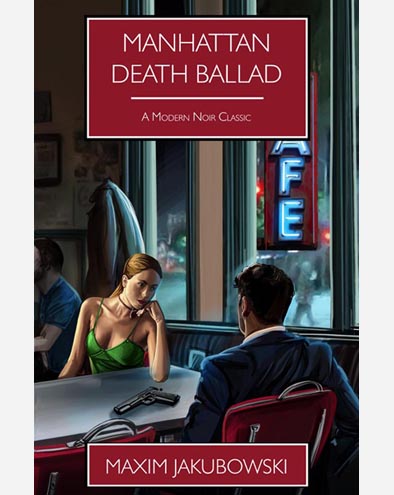
Sometimes the road you take presents you with choices about the onward journey. He wouldn’t call it opportunities. He was drifting, he was without joy.
On a lonely holiday, widower Leonard meets a beautiful assassin. From that day his whole life is turned upside down. Drawn into Meg’s world, Leonard becomes an unwitting killer, favoured by the mysterious Bureau for his efficient kills.
An evocative and compelling look at the trials and tribulations of an author-cum-assassin as he reflects on his life, his loves, and the death he delivers with careful precision.
A COMPANION TO JUST A GIRL WITH A GUN
‘Jakubowski always goes his own way which makes him an antidote to the sameness of much modern crime fiction.’ Paul Burke, Aspects of Crime
REVIEWS OF JUST A GIRL WITH A GUN
‘A great bit of storytelling. Jakubowski’s love of play shines. The end is poetic … a meditation on the weight and absurdity of life. It’s devastating.’ Paul Burke, Crime Time FM
‘‘
246pp approx. B format. Paperback Original.
ISBN: 978-1-84583-253-7
Cover by Martin Baines
Published 21 November 2025
ABOUT THE AUTHOR

Maxim Jakubowski worked for several decades in publishing and later owned the Murder One bookshop. He has written 20 novels (including 10 under a collaborative pen name, several of which made the Sunday Times top 10) and 5 collections of short stories. He is recognized as a major expert on popular fiction and reviewed crime for 12 years each for Time Out London and The Guardian, and won several awards in the mystery and SF & fantasy field. He is also a major editor of bestselling anthologies, and has been translated widely. He lives in London.

William Blick –
Jakubowski in the end absolutely triumphs with his rhapsodic prose….
Maxim Jakubowski’s new crime novel, Manhattan Death Ballad (Telos Publishing), which is the second part of a diptych, resonates as a powerful piece of contemporary crime fiction. The author alternates between delicate evocations of time, place, and images and then turns his words into a viper’s sting when the violence hits.
Ballad begins on a beach in Spain, and introduces the reader to Leonard, a wandering restless soul who is trying to forget his grief and pain over the recent loss of his wife. This anguish lingers with the character throughout the novel. He soon encounters the enchanting and mysterious “Meg”, who confides that she is a professional killer. Meg persuades Leonard to lure a man to his death and soon he is initiated into an organization called “The Bureau,” where he becomes a killer-for hire or a rather, a professional hitman.
Jakubowski has a rare talent for utilizing provocative language as well as languid prose to lull the reader into a lyrical state of mind and then snaps full force into action at a moment’s notice. The book plays out like a tragic song, and the author seems to string together seedy street scenes and entwine them into something rhapsodic in which the end result is darkness and death.
Leonard appears to be somewhat of a hapless romantic, and the novel is full of alluring beauties and femme fatales. He is an ambivalent anti-hero at best. He is full of contradictions and neuroses, a rare set of traits for hitmen in crime novels. For example, Jakubowski has Leonard lamenting on loneliness: “It’s the loneliness that kills you. The empty bed and empty room, the absence of a warm body by your side throughout the night. A human being with whom you discourse about nothing, share sights, thoughts, feelings.” In this passage, Jakubowski illuminates an aspect of the human condition in someone who would otherwise be considered just a cold-blooded killer. The author succeeds in creating nuanced and emotionally complex characterization of a hitman.
The mysterious “Bureau” which recruits agents and initiates the transgressions in the novel is a Kafka-esque touch. Ballad is somewhat of a danse macabre, andJakubowski excels in creating somewhat of a “death-dance” with each character involved in a hit. There are exchanges and interactions that have musical quality to them something akin to a moody, smoke- filled jazz club. In this novel, he has more in common with a deadlier version of Patricia Highsmith than with hard boiled writers like Chandler or Hammett.
Jakubowski influences are hard to pin down. He has written in many different genres, and this is a neo-noir, but quite unlike many other works of noir.The characters appear very matter of fact about death and treachery, which adds to the verisimilitude of the hitman narrative. Yet, in other aspects Jakubowski is quite poetic about Leonard and his prey. All the while Jakubowski fills the novel with clever, witty, and often playful dialogue such indicated by the passage below:
Maybe he should play along with her fantasy or the joke.
‘So how many people have you killed?’
‘That’s for me to know and you to remain in ignorance of, I
fear. A girl doesn’t put out to a stranger on their first date,
does she?’
‘How did you come to be in such an unusual profession?’
‘It’s a long, boring story …’
‘Meaning you won’t tell me?’
‘I won’t.’
Another great aspect of Jakubowski’s writing is his flair for setting. He seems to know all the nooks and crannies of the places he describes in the book and does not shy away from either the seedy or the mundane. The Manhattan the author creates in the novel appears deeply authentic and includes many vivid renderings of New York attractions or the not-so-attractive attractions. At times, Jakubowski tends to linger in the minutia, but the settingrings true, and the author imbues them with profound atmosphere. I am tempted to say that there might be too much atmosphere, and, at times, he risks favoring style over content. However, this reader can appreciate the atmospheric sketches along with the chilling streak of darkness.
Overall, Jakubowski’s novel is a mixed stew of hell-bent hitmen, murders-for-hire, ambiguous morality and sexuality, and vividly drawn milieus. While some minutia found this reader stifled at times, Jakubowski in the end absolutely triumphs with his rhapsodic prose and creates, as the title suggests, a thrilling “Death Ballad.”
William Blick is a literary/crime fiction and film critic; a librarian; and an academic scholar. He has published work in Senses of Cinema, Film Threat, Cinema Retro, Cineaction, and is a frequent contributor to Film International. He is contributing editor to Retreats from Oblivion: The Journal of Noircon. He is also an Associate Professor/Librarian for Queensborough Community College of CUNY.
https://retreatsfromoblivion.com/2025/10/27/book-review-maxim-jakubowski-manhattan-death-ballad-by-william-blick/
Paul Burke –
By Paul Burke, Aspects of Crime Magazine issue 2 Nov/Dec 2025
Jakubowski always goes his own way which makes him an antidote to the sameness of much modern crime fiction.
Two years ago Jakubowski published an erotic neo-noir Just a Girl With a Gun featuring the truly memorable assassin, Cornelia, and her sinister employers, an organisation known only as the Bureau. In this sequel/companion piece the Bureau is back but the new protagonist is Leonard. Leonard is on the run, not from anyone or anything, but from life itself. He has lost his wife, he’s grieving and that has cut him adrift from the world, he is lost and lonely.
Getting away from everything seems like a good idea. He winds up in the Barcelona holiday resort of Sitges. On a nudist beach he is attracted to a wonderful vision of sex and beauty, Meg. They share a couple of words and when she leaves he follows her back to a bar. Meg confesses she is a professional killer, here for a job. Her target is an Albanian named Bogdan, neither we nor Leonard know anything about the man. Meg offers Leonard a deal, he is clearly smitten, she will sleep with him if he helps her take out Bogdan.
Bogdan is a homosexual so Leonard will be the bait. He agrees. The next day he set out to seduce the Albanian. He lures him to a quiet stretch of the beach at night, where Meg is waiting. The execution of the hit is sloppy. The Albanian fights back when Meg tries to garotte him and in the messy aftermath Leonard the accomplice becomes Leonard the killer. The pair cover their tracks and flee the scene, licking their wounds. Neither is in condition or has the appetite for sex and in the morning Meg is gone.
Perhaps this strange phase of his life is over but Leonard is still running, still searching for a purpose, attempting to fill a void. He follows Meg to New York where he is waylaid by a young woman, Helen. Leonard’s life is bound by a series of attempts to connect with women in the present and the powerful memories of the women of his past.
Now he has come to the attention of The Bureau. They know about Sitges. They offer Leonard a job, or more properly, make him an offer he can’t refuse. Stare into the abyss long enough and eventually the abyss stares back at you. A tale of loss and transgression that is not as nihilistic or cynical as it might at first appear. It is empathetic, witty and disquieting for its raw humanity. The tale pops along at a cracking pace.
Jakubowski always goes his own way which makes him an antidote to the sameness of much modern crime fiction. Jakubowski is also the editor of Birds, Strangers & Psychos, a collection of stories based on Hitchcockian themes, which we reviewed in issue 1.